
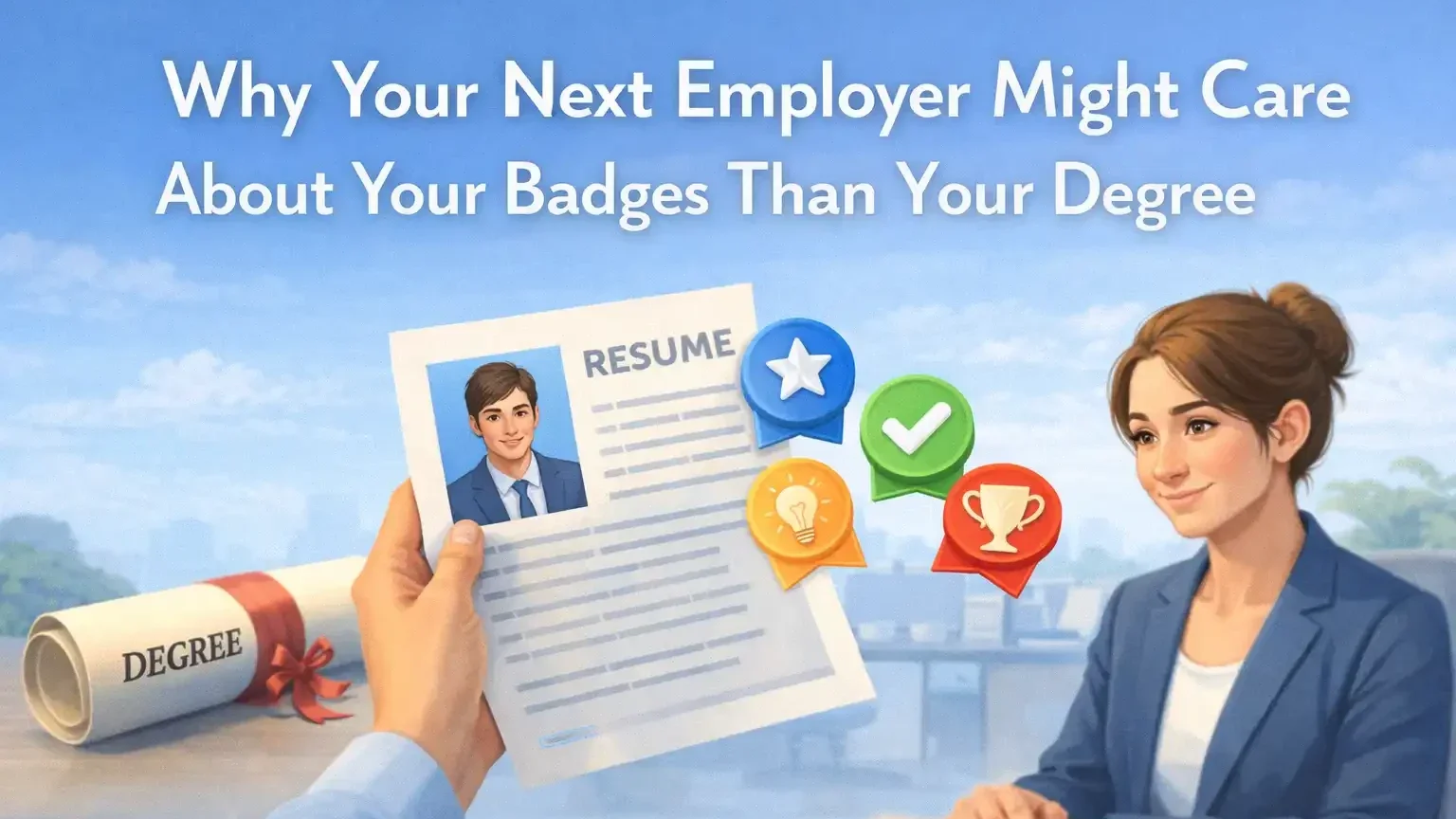
The four-year degree has had a good run. For decades, it stood as the undisputed gatekeeper to the professional world, a signal that a candidate possessed the baseline intelligence and perseverance to handle a desk job. But in 2026, that piece of parchment is being asked to share the spotlight, and in some cases, step aside entirely. We are in the midst of a seismic shift toward skills-first hiring, a trend where demonstrable abilities, verified by micro-credentials and digital badges, are becoming the primary currency of the job market.
The numbers are staggering. According to recent data, there are now over 1.85 million unique credentials in the United States alone . By 2025, more than half of employers had already removed degree requirements for many roles, a 30% increase from the previous year . This isn't just a passing fad; it's a fundamental restructuring of how talent is evaluated. As one industry leader put it, "A credential without skill is a promise. A skill without a credential is a secret". In 2026, the goal is to have no secrets—just provable, stackable skills.
The Death of the Resume as We Know It
The traditional resume, a static list of past jobs and academic achievements, is losing its power. In its place, employers are demanding verifiable evidence. A 2025 report found that 84% of HR leaders have caught or suspected candidates of exaggerating skills on their resumes. With the rise of AI-generated applications, this problem has only intensified. The solution is the digital badge—a micro-credential that contains embedded metadata, allowing employers to click, verify, and trust the claim instantly.
This shift is driven by a need for adaptability and learning agility. Technology, especially generative AI, is making job skills obsolete at a faster pace than ever before . A degree represents a body of knowledge that is, at minimum, three to four years old. A micro-credential, on the other hand, can represent a skill learned and validated last month. In fields like AI engineering, where candidates with specific micro-credentials are being prioritized by over 90% of employers, speed and relevance are everything .
Micro-Credentials: The New Signal of Initiative
So, what exactly is a micro-credential? It is a focused certification that validates a specific skill or competency. They are the building blocks of the modern career, often referred to as "stackable skills." A candidate might earn a badge in SQL, another in Python, and a third in data visualization, creating a custom "degree" in data analytics without the time and expense of a traditional program.
Why do employers value them? Because they signal something a degree cannot: intentional initiative. A candidate who spends their evenings and weekends earning a Google Data Analytics certificate or an IBM AI Engineering badge is showing a hunger for learning and a passion for their field that goes beyond a transcript . They are proving they can master in-demand tools and concepts, often through rigorous, proctored exams and hands-on projects. This is why 96% of employers believe micro-credentials strengthen a job application, and 90% are willing to offer higher starting salaries to candidates who hold them.
However, not all badges are created equal. Research from the Brookings Institution in early 2026 confirms that "relevance drives return" . A JavaScript certification is gold for a software developer, but irrelevant for a marketing manager. The data shows that a worker's first job-relevant micro-credential is associated with a 3.8% wage premium, and stacking additional relevant credentials adds further value. Irrelevant badges? They yield almost nothing .
The Student's Dilemma: From Subject Overload to Strategic Mastery
For students preparing for this new world, the challenge is clear: how do you strategically plan your learning to acquire these in-demand, job-relevant skills without succumbing to stress and information overload? You can't just study everything. You need a precise plan.
This is where platforms like Prexms are changing the game. Navigating the shift from broad, theoretical learning to targeted skill acquisition requires a roadmap. Prexms helps students plan precisely what to study and exactly how many revisions they need to master a subject or chapter, effectively reducing the anxiety of subject overload.
Whether you are a 12th-grader aiming for JEE, a college graduate targeting GATE or CAT, or a professional preparing for UPSC or SSC, the path to mastery is no longer about passive reading. It's about active, measured progress. Prexms provides a comprehensive ecosystem for this journey, including an AI Preparation Engine that personalizes your study plan, thousands of chapter-wise mock tests to validate skill acquisition, and full-length mock tests that simulate the real exam pressure. With access to the latest syllabus and e-books, students can ensure their learning is current and relevant—just like the micro-credentials the job market demands.
Learning also needs to be engaging. Through features like Prexms League, students can compete with peers across India, turning preparation into an interactive challenge where you can win exciting rewards like iPhones, smartphones, and gadgets. This gamified approach, combined with fun learning games, ensures that building your skill stack is a journey of continuous motivation, not burnout.
How the Hiring Process Has Evolved
In 2026, the interview process itself has transformed to validate these new credential signals. It's no longer enough to say you know a subject; you have to prove it. Hiring managers now routinely use:
Skills Assessments: Short, intense tests to verify technical proficiency on the spot.
Portfolio Reviews: A deep dive into real-world projects, GitHub repos, or case studies that demonstrate applied knowledge.
Job Simulations: Candidates are given a typical problem they would face on the job and asked to work through it in real-time .
This approach doesn't just level the playing field; it democratizes it. For early-career workers and those without a bachelor's degree, a job-relevant micro-credential can be a life-changer. Brookings data shows that for workers without a degree, a first relevant non-degree credential is associated with a massive 6.8% wage premium—nearly double the return for college graduates .
Platforms for Every Stage
The demand for verified skills spans every career stage and industry. Recognizing this, Prexms has designed its packages to cater to specific multi-year preparation journeys, ensuring that students build a deep, foundational understanding that can later be supplemented with specific micro-credentials. The APEX (1 year), PRIMEX (2 years), and SCHOLAR (3 years) packages are built to target competitive exams like JEE, NEET, NDA, and even professional exams like CAT, XAT, and GATE.
By offering updated mock tests and study material for classes 6-12 and a wide array of competitive exams, Prexms ensures that students are not just learning, but practicing with the latest patterns. This constant testing and revision is the bedrock of skill mastery. The convenience of the Prexms Academy mobile app means this powerful preparation engine is always in your pocket, ready to turn a spare 15 minutes into a productive study session, available on the Google Play Store.
The Future is Verified
The shift to skills-first hiring isn't about the death of the degree, but about the rise of a more nuanced, accurate, and fair system of evaluating talent. Degrees provide a broad foundation, but badges and micro-credentials provide the specialized, verified proof of what you can actually do. They are the transcripts of tomorrow, offering real-time relevance and a clear return on investment.
In 2026, the most successful candidates will be those who treat their careers as a continuous construction project, stacking verified skills—one badge at a time—to build an unassailable fortress of expertise. And with the right preparation platform, the stress of "what to study next" is replaced by the confidence of a precise, strategic plan for mastery.
💬 Leave a comment or question