
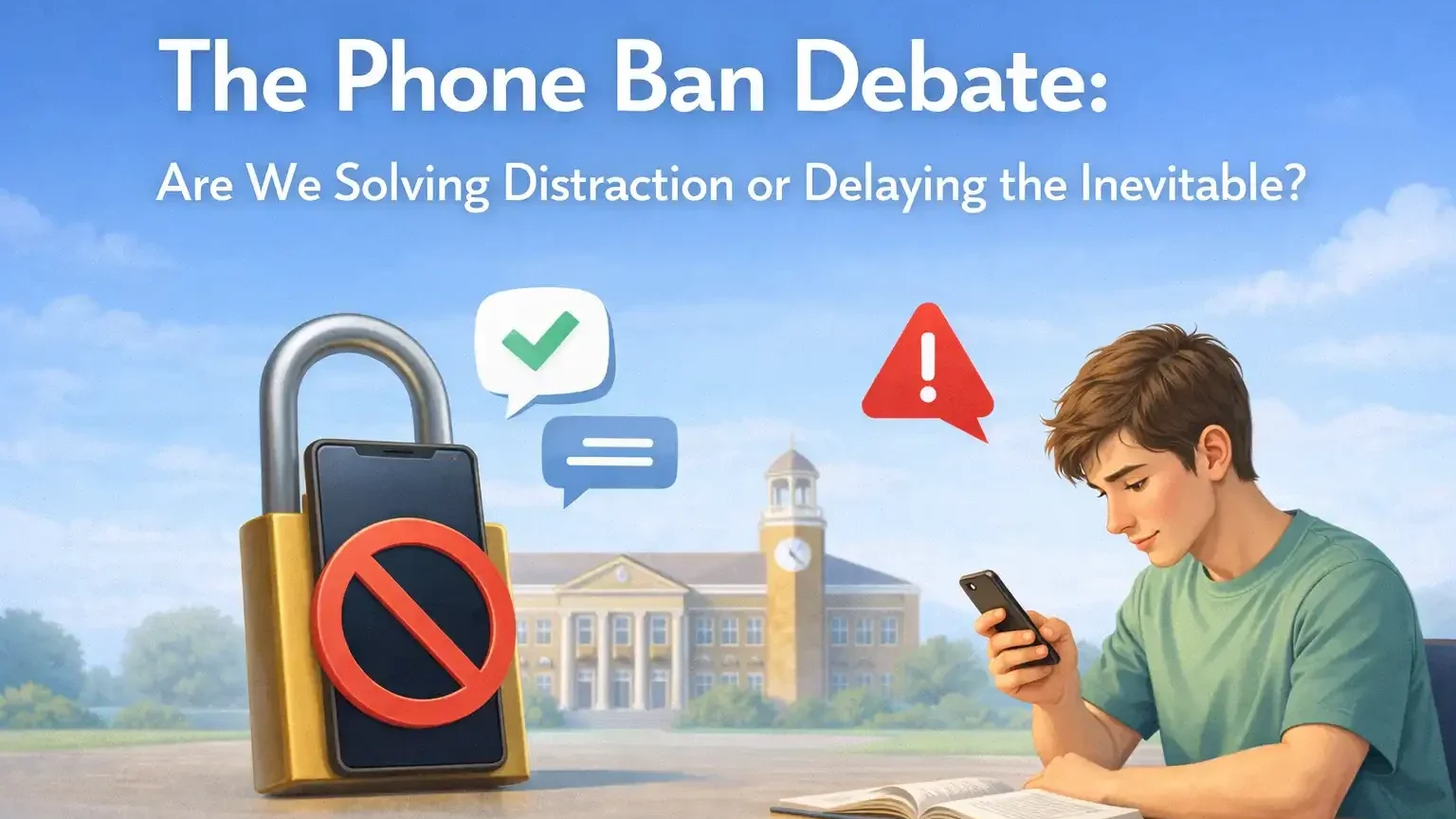
The year 2026 marks a turning point in classrooms worldwide. From New Jersey's new law requiring public schools to ban phones throughout the school day, to similar restrictions taking effect in South Korea and Brazil, the movement to remove smartphones from schools has reached critical mass. Supporters point to improved focus, reduced anxiety, and better academic outcomes. But beneath these policy changes lies a deeper question: Are we truly solving the distraction problem, or are we simply delaying the moment when young people must learn to navigate a world filled with technology?
The Case for Phone Bans
The arguments for restricting phones in schools are straightforward and increasingly backed by real-world results. Teachers report that when devices are put away, students pay more attention in class, interact more with peers during breaks, and experience less anxiety about social media. Academic performance often improves, particularly for students who previously struggled. The logic is simple: removing the source of distraction allows learning to take center stage.
In districts that have already implemented bans, educators describe hallways filled with conversation instead of silent scrolling, and classrooms where students look up at teachers instead of down at screens. For many schools, these policies have been transformative, creating calmer, more focused learning environments.
The Counterargument: Avoidance Isn't Education
Yet a growing number of educators and experts warn that prohibition without education is a missed opportunity. If schools simply remove phones without teaching students how to use them responsibly, what happens when those students graduate and suddenly face a world saturated with technology without any guardrails?
The concern is that blanket bans treat the symptom rather than the cause. Students need to develop digital literacy—the ability to navigate technology purposefully, manage distractions, and use devices as tools rather than being controlled by them. These skills don't develop automatically; they require guidance, practice, and gradually increasing responsibility.
There's also an important distinction to make between personal devices used for entertainment and educational technology used for learning. Smartphones and tablets can deliver powerful educational tools when properly integrated into instruction. Completely banning devices may inadvertently remove valuable learning opportunities along with the distractions.
The Research Picture
Studies on phone bans show mixed results. Some research indicates improvements in test scores and reduced absences after bans are implemented. Other studies find no clear differences in mental health, sleep, or grades between schools with bans and those without. What emerges clearly is that context matters enormously—how a ban is implemented, what alternatives are provided, and whether students understand the reasons behind the policy all influence outcomes.
What researchers agree on is that bans alone are insufficient. Lasting change depends on helping students develop healthy digital habits and stronger media literacy. The goal shouldn't be to protect students from technology forever, but to prepare them to use it wisely.
The 2026 Paradox
This year presents an interesting contradiction. While schools crack down on personal phones, there's simultaneously a massive push to integrate more artificial intelligence and technology into education. The message can feel confusing: embrace digital tools, but ban the devices that deliver them.
In Kota, India—the country's coaching hub for engineering aspirants—a viral video showed JEE toppers proudly displaying basic keypad phones instead of smartphones. The debate that followed captured the divide perfectly: some praised the students' discipline, while others argued that smartphones, when used intentionally, can be powerful educational tools with AI-driven learning apps and resources.
A Better Approach: Intentional Use Over Blanket Bans
The most thoughtful voices in this debate advocate for something more nuanced than either complete prohibition or unchecked access. Different approaches work for different age groups and contexts. For younger students, stricter limits may be appropriate. For older students preparing for college and careers, guided practice with technology may be more valuable than avoidance.
What matters most is intentionality—helping students understand why they're using technology, what they hope to accomplish, and how to recognize when devices are helping versus hindering their goals. This is where educational technology platforms play a crucial role.
How Prexms Turns Screen Time Into Productive Time
This is where platforms like Prexms enter the conversation. Rather than adding to digital distraction, Prexms helps students use their devices purposefully for learning. Available at prexms.com, the platform addresses one of the biggest sources of academic stress: the overwhelming feeling of not knowing what to study or how much revision remains.
Prexms helps students plan precisely what to study and exactly how many revisions they need for each subject or chapter. This clarity reduces anxiety about subject overload and replaces chaos with a clear roadmap. When students know exactly what they need to accomplish, they're less likely to fall into the trap of mindless scrolling.
The platform's AI Preparation Engine creates personalized study paths, ensuring students use their screen time efficiently. Beyond planning, Prexms offers thousands of chapter-wise mock tests, full-length practice exams, ebooks updated with the latest 2026 syllabi, and fun learning games that provide healthy mental breaks while still engaging with educational content.
For students preparing for competitive exams, Prexms covers classes 6-12 as well as JEE, NEET, NDA, SSC, HSSC, UPSC, CAT, XAT, MAT, and GATE—all with materials updated to the latest syllabus requirements. The platform offers three major packages: APEX (1 year) for focused preparation, PRIMEX (2 years) for extended journeys, and SCHOLAR (3 years) for long-term foundational building.
Perhaps most importantly, Prexms addresses the social dimension of learning through the Prexms League, where students compete with peers across India and win exciting rewards like iPhones, smartwatches, and gadgets. This gamification transforms solitary studying into community engagement, creating positive associations with learning and reducing the isolation that often leads to mindless phone use.
The Prexms Academy mobile app, available on Google Play, puts all these tools in students' pockets—teaching them, through daily practice, that their devices can be instruments of achievement rather than sources of distraction.
Finding Balance
The phone ban debate ultimately asks us to consider what kind of relationship with technology we want young people to have. Do we want them to see devices as dangerous temptations to be avoided at all costs? Or do we want them to develop the skills to use technology purposefully, managing distractions and leveraging digital tools to accomplish their goals?
The answer likely lies somewhere in the middle. Schools need policies that protect focused learning time. But those policies should be paired with education about digital citizenship, opportunities to practice responsible technology use, and tools that demonstrate the positive potential of screens. Platforms like Prexms show what's possible when technology is designed with student wellbeing and academic success in mind.
As we move through 2026, the most effective approach won't be the strictest ban or the most permissive policy, but the one that helps students build the self-regulation, purpose, and skills they'll need to thrive in a world where technology is everywhere—and nowhere more so than in their own pockets.
💬 Leave a comment or question